
I ended my time in Greece writing about surveillance at a site with almost nothing left to see. I started the Sicily leg of this trip at a site with almost the opposite problem: too much to take in at once. Standing in the Valley of the Temples at Agrigento, surrounded by sanctuaries that have survived nearly intact for over two thousand years, it was hard to know where to look first.

As I mentioned in my last post, this summer’s fieldwork in Greece and Sicily (Magna Graecia) was made possible by a Special Projects Grant and an Amelia V. Gallucci-Cirio Center for Italian Studies grant from Fitchburg State University, both supporting research for my book project on the relationship between philosophy, rhetoric, democracy, and authoritarianism. Agrigento seemed like the right place to start this leg, because it preserves a city that never fully settled into one form of government, temples, assembly spaces, and inscriptions all bearing traces of a polis moving between tyranny and something closer to participatory rule.
But the site that ended up reshaping this entire research trip wasn’t a temple. It was a volcano.
What Etna Took Back
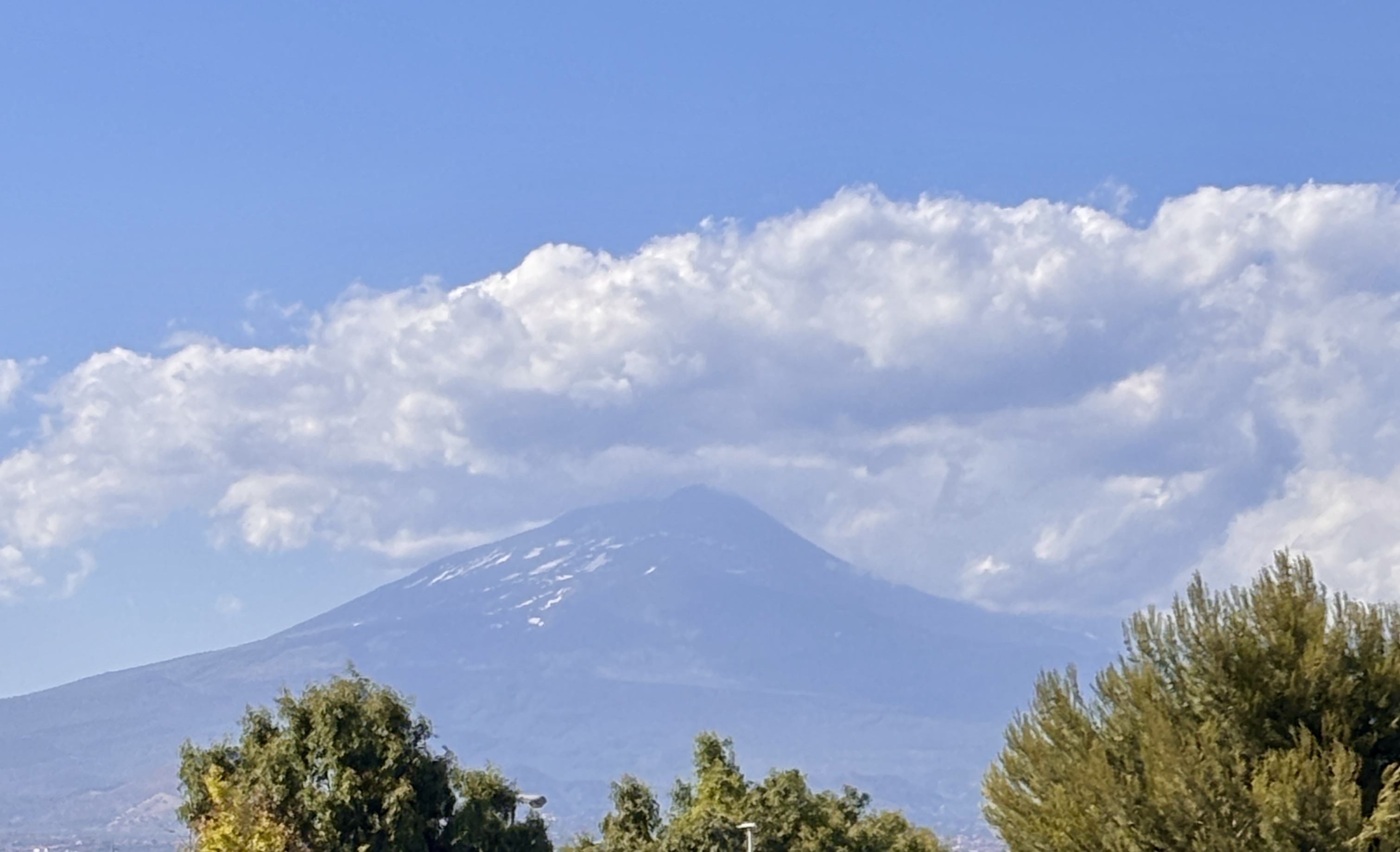
There’s a story, reported by Diogenes Laërtius, about the philosopher and rhetorician Empedocles. Toward the end of his life, he’s said to have climbed Mount Etna and thrown himself into the crater, hoping his followers, finding no body, would conclude he’d ascended into a new life as a god. Etna didn’t cooperate. According to the account, the volcano cast one of his bronze sandals back out of the flames, leaving physical evidence that contradicted the story he’d staged for himself.

I found myself thinking about that sandal for a long time, both standing near Etna and later on Stromboli, a small Sicilian island that’s been erupting more or less continuously for centuries. Aristotle, in a now-lost work called The Sophist, is reported to have credited Empedocles, not Corax or Tisias, as rhetoric’s true inventor. If that’s right, rhetoric’s origin story isn’t just political. It’s geological.
Here’s the argument I’ve started building from that idea: Sicily’s volcanic instability didn’t sit quietly in the background of its political history. It actively generated the need for persuasion in the first place. When your land can be reshaped overnight by an eruption, boundary disputes become inevitable, and someone has to be able to argue convincingly about where a property line used to run. But the sandal matters just as much as the eruption itself. It’s a reminder that the material world eventually answers back on its own terms, no matter how persuasive the story someone tells about it.

That tension, rhetoric’s power to shape belief against the physical world’s stubborn refusal to fully cooperate, is exactly the kind of limit I want to trace through this book. It’s also become the seed of an entirely new article, which is not something I expected a volcano to hand me.
Where Rhetoric Meets Its Limits: Syracuse
From the volcanoes, I moved to Syracuse, where rhetoric’s limits show up in a very different form: political failure.
Syracuse is traditionally credited as rhetoric’s birthplace, and standing in the Greek Theatre at the Neapolis Archaeological Park, it’s easy to see why. The acoustics, the sightlines, the way the seating wraps around and focuses attention toward the stage, none of it is accidental. Corax and Tisias are said to have developed early rhetorical theory here, and the theater itself feels like an argument for why that theory mattered so much in this particular city.

A short walk from the theater, carved into the same limestone quarry, is a cave known as the Ear of Dionysius, named for its uncanny resemblance to a human ear and for the acoustic effect that made it useful, according to legend, to Dionysius I. The story goes that the tyrant used the cave’s shape to amplify and funnel sound upward to a listening chamber above, allowing him to eavesdrop on prisoners held inside without their knowledge. Whether or not the tale is strictly accurate, and the acoustics are genuinely striking either way, it captures something important about how rhetoric and power operated together in this city. The same quarry that produced a space built for open civic persuasion also produced a space built for covert listening. Syracuse didn’t just develop the theory of public speech. It also developed the infrastructure for controlling who could speak freely and who was always, potentially, being overheard.

Just across the way sits Ortygia, the small island forming the historic core of Syracuse, and the place where Plato most likely attempted something remarkable and ultimately doomed: talking a tyrant into becoming a philosopher-king. Plato traveled to Syracuse multiple times to advise Dionysius II, hoping to reshape his rule through philosophical dialogue. It did not go well. At one point, Plato was detained and, according to some accounts, sold into slavery after falling out of favor.
Standing in Ortygia, dense with temples, palace remains, and administrative buildings, I kept returning to a question I haven’t fully answered yet. What happens when you try to introduce a genuinely different mode of truth-telling into an environment already built for something else? Syracuse wasn’t a neutral backdrop for Plato’s experiment. It was a city whose entire civic infrastructure, its theaters, courts, and rituals of political display, rewarded spectacle and performance. Philosophical dialogue never really stood a chance against that.
A short walk from Ortygia’s temples, the Paolo Orsi Museum holds inscriptions from Dionysius’s era, decrees and honorific texts that functioned as a kind of formalized public speech, rulers using writing to project authority in ways rhetorical theory tried both to explain and, in Plato’s case, to redirect.
More Thinking and Reading
I didn’t expect this leg of the trip to generate new writing projects, but that’s exactly what happened. The Etna and Stromboli material is becoming its own article on volcanism and the origins of rhetoric. And thinking about Sicily alongside islands I visited in Greece, particularly Aegina and Corfu, has opened up a second project on how island geography itself, bounded, exposed, and sometimes literally unstable, shapes the conditions under which both democracy and tyranny become possible.
I’m back home now, sorting through weeks of notes and photographs, trying to figure out how a theater, a tyrant’s island, a rhetorician’s hometown, and an erupting mountain all belong in the same chapter. I don’t have that fully worked out yet. But I suspect the answer has something to do with a bronze sandal that refused to stay buried.


