
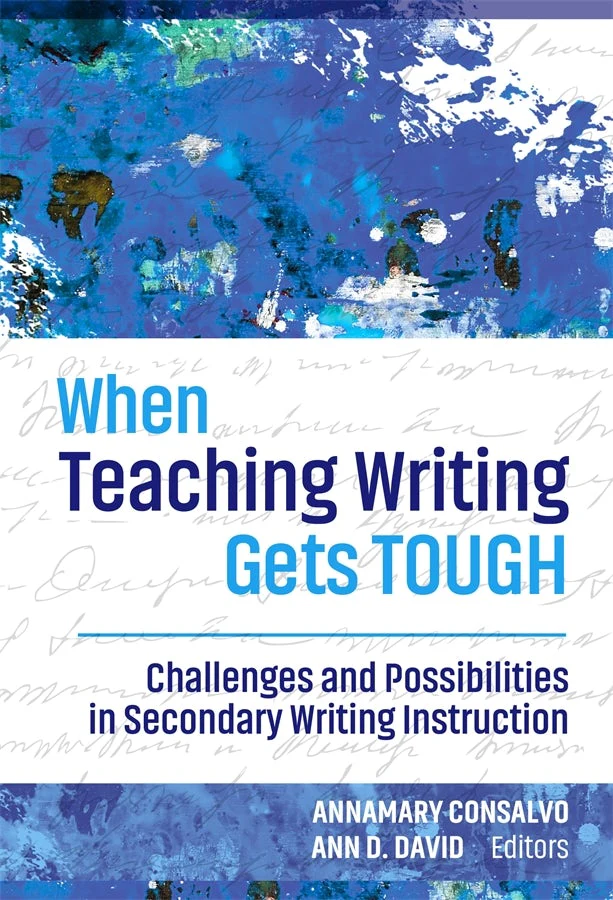
In this double interview from November 2024, Elise Takehana (University of Texas, El Paso) and J.J. Sylvia IV (Fitchburg State University) discuss some larger questions around GenAI, building off of their co-authored chapter in the book, When Teaching Writing Gets Tough: Challenges and Possibilities in Secondary Writing Instruction.

Elise: How has GenAI impacted how communication programs articulate their value or alter their curriculum in the face of easily generated written and visual content?
J.J.: I find this question fascinating because it highlights how GenAI has impacted the written word first, but the impacts of visual content are not far over the horizon. Anyone who includes substantial writing assignments has already had to grapple with this issue in one way or another — even ignoring it is response! But the technology for visual content is not quite past that threshold where those in the visual arts are truly feeling its impact yet.

In conversations with students, it is clear they are concerned about the impact that GenAI will have on the visual arts in the forthcoming decade. However, I’m not yet hearing much work on updating curriculum. There is, for the moment, a bit of a “wait and see” approach, especially as several unions in the communication arts have gone on strike and/or negotiated to attempt to mitigate the worst impacts of GenAI on their fields.
Of course, we haven’t really grappled with written word GenAI at the curriculum level, either. Most of us are taking a patchwork approach of updating individual classes to address these challenges. As you and I know from our past collaborations, curricular and institutional changes can be slow in academia, even at the nimblest universities.
What impact is generative AI having on the field of Digital Humanities?
Elise: The emergence of generative AI has really pressed the need for transdisciplinary digital literacy skills. Knowing how to ethically use GenAI and create representative LLMs requires that one know not only how algorithms and computers work, but also how language, culture, and social systems contextualize what generative AI should do. Digital humanities have long been invested in interdisciplinary, heuristic exploration and encourage their practicants to learn many ways of knowing. That flexibility and culturally situated interest in technology makes the field well situated to forward just that type of digital literacy.
Digital humanities and other interdisciplinary programs around technology and computers were already working to reimagine curricula that laid out the ethical and human issues around technology alongside the mathematical, computational, and engineering knowledge necessary to engage fully in those ethical tensions. Computer science programs in and out of the college space have worked at broadening their appeal and approach become relevant to a more diverse student body. Mathematics programs are thinking more about ethics in their field and have an established interest in ethnomathematics. The steady growth of the digital humanities has engaged scholars across the humanities to use, understand, critique, and build technological tools. Much of the groundwork for putting humanities and sciences in deeper conversation with one another is there and perhaps this rapid growth of GenAI will catalyze more integrated programs.
J.J.: What challenges do writing teachers face when incorporating GenAI tools like ChatGPT into writing and composition classes?
Elise: Teaching writing is a challenging endeavor for many reasons, but one of the most latent, in my own experience, is fostering a care for one’s writing. It is not easy to know precisely what you mean to say to a specific constituency and to gauge if how you wrote it carries the message you mean to relay. Even explaining what voice in one’s writing means and how one cultivates a voice necessitates that students care to want to understand themselves, their perspective and its broader context, and their impression on others. On top of that, often their training in school teaches them to write in overly prescriptive and generic ways, ways that generative AI does well already.
Incorporating GenAI into the writing classroom can certainly show students how quickly one can generate a product much faster than those three hours the night before a paper is due, but it can also show students that the process of articulating their own thoughts in their own words is a chance to get to know themselves even when they are not writing in a personal register. Perhaps that means that considering the creative process of writing and its flexibility will be a more fruitful focus to engage students in coming to know their world view through how they write.
What ethical concerns around the use of GenAI do you find get overlooked in the current moment?
J.J.: I’ve seen very strong ethical critiques related to biases of AI, its environmental impact, and the poorly paid “hidden labor” needed to develop GenAI models. But I’ve seen much less written from a posthuman ethical framework that considers how this changes our relationship to and understanding of the world.
From this perspective, the invention of new media have always already been inextricably linked to and part of these changes. Media scholars have long argued that the written word, for example, ushered in more abstract thinking while also harming our ability to remember things. However, as audio and video-based social media have come to dominate the last decade, we are firmly moving into an era of what scholars have called secondary orality — and era in which we still are able to read, but have deprioritized that skill in lieu of the spoken word, both digitally and in-person. GenAI will likely contribute to the decline in the overall amount of writing we do, accelerating this shift into secondary orality. In what ways will this impact our thinking? Will it harm the abstract reasoning skills that advanced scientific and philosophic inquiry over the last two millennia? Will there be developments to our thinking to propel us in new and exciting directions?
Those are the posthuman ethical questions that at turns excite and worry me.


