
This summer I found myself standing in the spot where the seeds for the final destruction of Ancient Greek democracy were sown. There was a split in the emotional tugs across the millennia that felt utterly disorienting. On one hand, I was overwhelmed by the weight of history in this spot where the philosopher Aristotle taught a young Alexander (later, “The Great”). But in the present moment, a single local employee was carefully watching my every footstep, making sure I didn’t use my tripod stick to capture video of a site that has almost no preserved ruins. This surveillance made the ancient site of Mieza in Naoussa stand out.

I’ve spent this summer trekking around Greece and Sicily (Magna Graecia) thanks to a Special Projects Grant and an Amelia V. Gallucci-Cirio Center for Italian Studies grant from Fitchburg State University. I’m trying to better understand the relationship between philosophy, rhetoric, democracy, and authoritarianism for a book project that is in the very early phases of development. Of the dozens of sites I have visited, Mieza had both the fewest visitors and the most intense surveillance. The ancient theater just down the road, an active archaeological site with exposed and accessible ongoing digs, had no one around for kilometers. Why such surveillance at Mieza? This is a question I’m still pondering as I wrap up my trip in Athens, compiling my notes and thoughts collected over the past few weeks. There is clearly still a discomfort and uncertainty related to this site. There are only two signs across the entire site, and they each devote one line to mentioning that this is where Aristotle taught Alexander.
However, this site is central to another question I’ve been wrestling. Rhetoric came into prominence alongside democracy. Philosophy in Athens began as a critique of this rhetoric and likely was only possible due to the Greek alphabet and widening literacy. At least with Socrates and Plato, this philosophy was anti-democratic. Socrates, Plato, and Aristotle all had students who took actions that were devastating to Athenian democracy. How can we make sense of this entanglement of writing, persuasion, truth, and democracy?
What Media Archaeology Actually Looks Like
Media archaeology is a method that takes seriously the idea that communication technologies are not just tools that we use. They are systems and environments that we inhabit which shape what we can think, say, and become. When scholars like Jussi Parikka and Wolfgang Ernst argue that we need to read media through their material histories, they mean something quite specific: the physical infrastructure of communication, the architecture, the inscriptions, the spatial arrangements, carry meaning that no text alone can fully capture. Understanding Plato’s philosophy means understanding the history of the places he inhabited, and how those places shaped him.
In other words, you have to go to the place.
So I went. With a notebook, a camera, and a set of research questions centered on one central problem: how did the material and spatial design of Ancient Greece, in the wake of the invention of the first alphabet with vowels, mediate the relationship between truth, persuasion, and political authority? Said another way, what do communication technologies tell us about ancient power?
Before Writing: Eleusinian Mysteries
To better understand this, I traveled to a variety of sites. Before writing, in the age of epic Greek poems, knowledge was more embodied, shared through songs, poems, and rituals. The sanctuary of Demeter and Kore at Eleusis offered an opportunity to better understand the methods of this pre-alphabetic world.
The Telesterion, where the Eleusinian Mysteries occurred, is just up the hill from a small cave, where a temple to Hades was once located. The cave is believed to have bee used as a location to represent Persephone’s annual return from the Underworld:

In Ancient Greek, the same word could be used for both seeing and knowing — εἴδω (eido). Experiencing something for one’s self was the way to come to know it, and these temples, dramas, and rituals were the way to pass on such knowledge. The drama of Greek architecture becomes apparent when you stand in these spaces and understand how massive and how beautiful they were. Admittedly, I can understand Socrates’ and Plato’s critiques of writing a little bit better after witnessing the spaces. Written descriptions feel small when compared to seeing and conversing with others in these spaces.
These rituals were protected by the legal codes of Ancient Greece as well. Divulging the mysteries to the uninitiated was considered, legally, equally as bad as harming democracy. One of Socrates’ students, Alcibiades, would commit both of these crimes. While drunk one night in his own home, he imitated the rites to his guests. He was condemned and his property was confiscated despite his immense popularity and status as a military leader at the time.
For me, this site makes concrete the importance of knowledge being passed on through embodied practices that are witnessed and not inscribed or written. This is the heritage from which Socrates and Plato came that made them uncomfortable with writing even as literacy reshaped how they were able to think about the world.
The Corinthian Bema & Olympian Echo Stoa
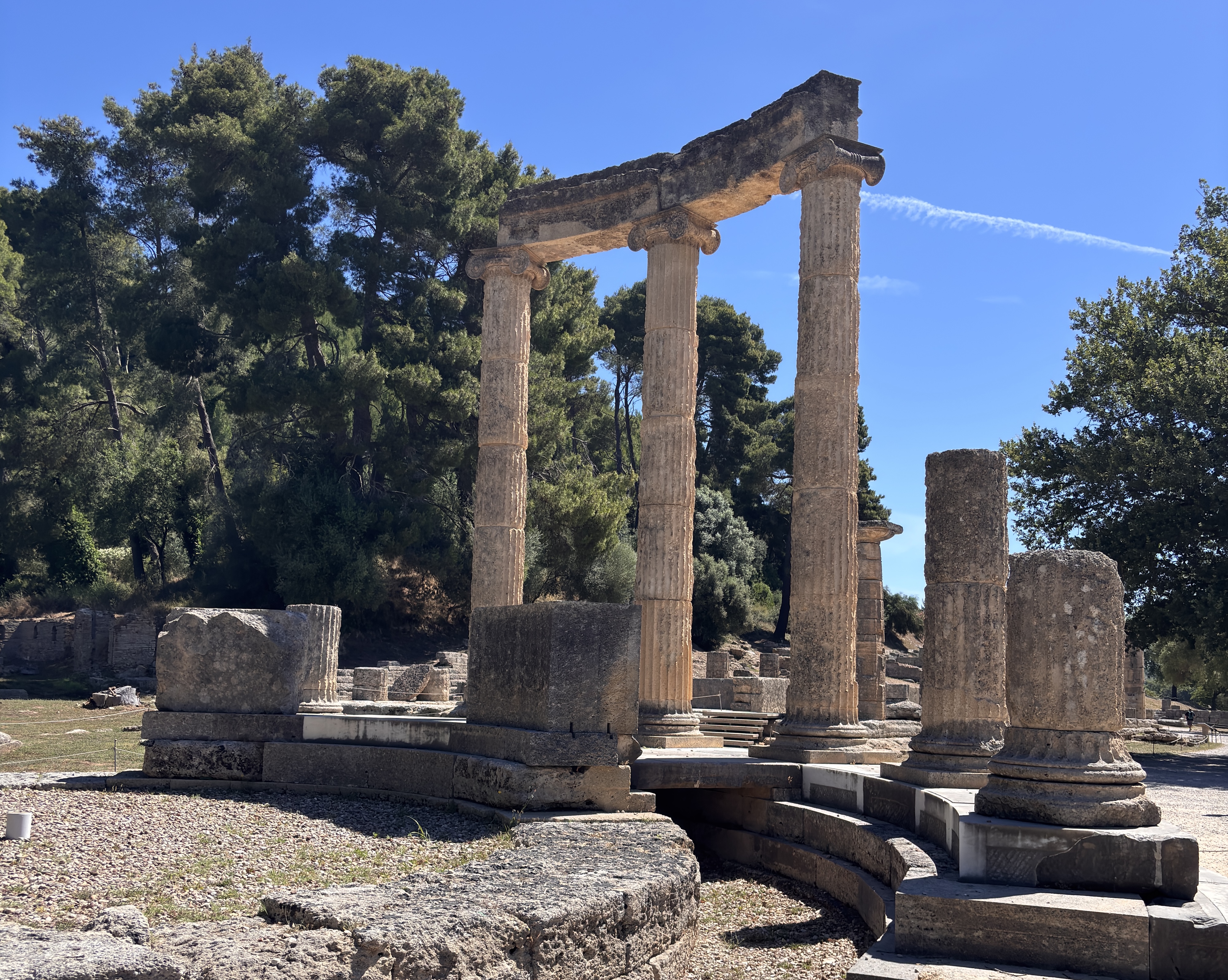
Visiting other sites reinforced for me that while literacy rates increased, speech was often still the most prominent act that structured power. This was true at Olympia where athletes would go to the Bouleuterion to verbally swear to follow the rules of the Olympic Games and compete honorably. Notably, this was done while standing on the genitals of the goat — truly an example of embodied ritual.
The Temple of Zeus, just across from the Bouleuterion:

Corinth is a massive archaeological site, in part because its strategic location as the isthmus between the Peloponnese and Attica meant it was a constant site of trade and battle. After the Romans conquered it, they added a Bema used for public ceremonies and for a location for government officials to address the citizens. The Bema quite literally elevated the voice of those who wielded the political power to stand atop it:

More Thinking and Reading
Between this trip and my travels in Sicily, I’ve compiled a nice collection of books spanning three different languages that I’m still working my way through:

I’m now happily working to connect my experiences over the last month to the larger story I’m trying to tell about media history in Ancient Greece. Experiencing these sites first hand has helped to deepen my understanding and interpretation of this history.


